Науковий журнал "Соціологія: теорія, методи, маркетинг"
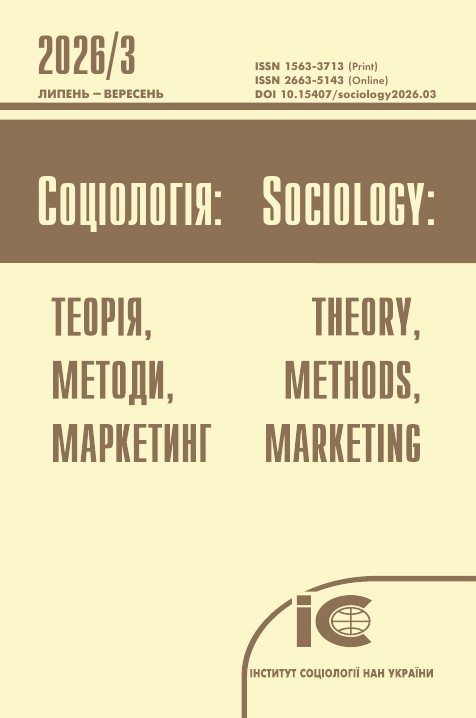
ОСТАННІЙ ДРУКОВАНИЙ НОМЕР
НАЙСВІЖІШІ МАТЕРІАЛИ У ВІДКРИТОМУ ДОСТУПІ
Гендерні виміри турботи: сімейне піклування про людей старшого віку в Україні крізь призму установок і практик
stmm. 2026 (4): 178–195
DOI
Повний текст:
ОЛЕНА СТРЕЛЬНИК, докторка соціологічних наук, старша наукова співробітниця Інституту соціології НАН Україні (01021, Київ, вул. Шовковична, 12)
olena.strelnyk@gmail.com
https://orcid.org/0000-0001-9027-4758
SCOPUS ID: 57200148918
МИХАЙЛО СОССА, студент маґістерської програми із соціокультурної антропології, Гейдельберзький університет, Німеччина (2 Voßstraße, Gebäude, 4110, 69115, Heidelberg, Germany)
mihaelsossa@gmail.com
https://orcid.org/0009-0004-4704-2934
Центральне дослідницьке питання статті: наскільки сімейне піклування про людей старшого віку в Україні є гендерованим на рівні соціокультурних установок та на рівні практик. Тобто чи покладає українське суспільство відповідальність за догляд за близькими старшого віку переважно на жінок і яким чином ця відповідальність фактично розподілена між жінками й чоловіками у повсякденних практиках?
Стаття спирається на дані авторського дослідження, реалізованого за змішаною методологією. Кількісна частина базується на даних національних репрезентативних опитувань, проведених за авторською методологією (2025, 2026). Якісна частина ґрунтується на матеріалах глибинних інтерв’ю з жінками (n = 13) та чоловіками (n = 13), які є основними доглядальницями та доглядальниками літніх родичів (2025–2026).
Автори стверджують, що соціокультурні очікування щодо розподілу ролей у доглядовій праці є слабко гендерованими: переважна більшість опитаних вважають, що стать не є визначальним чинником у розподілі доглядових обов’язків. Водночас на рівні практик турбота є більш виразно гендерованою: жінки частіше залучені до інтенсивного догляду, що є наслідком як демографічного дисбалансу (превалювання жінок серед населення старших вікових груп), так і складного впливу гендерного порядку на повсякденні практики, зокрема у контексті розподілу доглядових ролей у гетеросексуальних партнерствах. Розрив між установками та практиками відображає ширший структурний вплив гендерного порядку на розподіл доглядових ролей.
Ключові слова: доглядова праця; сімейний догляд; гендерні ролі; гендерні установки; Україна
Джерела:
Acht, M. & Rebaudo, M. (2025). A gender gap in gender gaps: Social norms and housework reporting. Empirical Economics, 68, 2977–3029. https://doi.org/10.1007/s00181-024-02710-z
Alzheimer’s Disease International. (2018). World Alzheimer Report 2018: The state of the art of dementia research: New frontiers. Alzheimer’s Disease International.
Anttonen, A. & Sipilä, J. (1996). European social care services: Is it possible to identify models? Journal of European Social Policy, 6(2), 87–100. https://doi.org/10.1177/095892879600600201
Björk, S. (2015). Doing, re-doing or undoing masculinity? Swedish men in the filial care of aging parents. NORA—Nordic Journal of Feminist and Gender Research, 23(1), 20–35. https://doi.org/10.1080/08038740.2014.978369
Björk, S. (2017). Gender and emotions in family care: Understanding masculinity and gender equality in Sweden (Göteborg Studies in Sociology No. 66). Department of Sociology and Work Science, University of Gothenburg. Online publication.
Bridges, T. & Pascoe, C.J. (2014). Hybrid masculinities: New directions in the sociology of men and masculinities. Sociology Compass, 8(3), 246–258. https://doi.org/10.1111/soc4.12134
Cabinet of Ministers of Ukraine. (2024). On approval of the Strategy of Demographic Development of Ukraine for the period up to 2040. [In Ukrainian]. Retrieved from: https://zakon.rada.gov.ua/laws/show/922-2024-%D1%80#Text [=Кабінет Міністрів України. (2024). Про схвалення Стратегії демографічного розвитку України на період до 2040 року (Розпорядження від 30 вересня 2024 р. № 922-р).]
Dutchak, O. (s.a.). Hierarchies of care and social reproduction in Ukraine before and during the war. In: K. Krulišová, M. O’Sullivan, & A.T.R. Wibben (Eds.), Re-thinking feminist perspectives on war, peace and (in)security. Forthcoming.
Dutchak, O., Fedyuk, O., & Oksiutovych, A. (2026). Unpromising segment: Elderly care in wartime Ukraine. In: E. Palenga-Möllenbeck, D. Gabriel, O. Fedyuk, & K. Krause (Eds.), Transnational organization of labour, mobility, and senior care in Central and Eastern Europe. https://doi.org/10.17645/si.12060
Finch, J. & Mason, J. (1993). Negotiating family responsibilities. Routledge. https://doi.org/10.4324/9780203393208
Graham, H. (1983). Caring: A labour of love. In: J. Finch & D. Groves (Eds.), A labour of love: Women, work and caring (pp. 13–30). Routledge. https://doi.org/10.4324/9781003303930
Gruber, J., McGarry, K. M., & Hanzel, C. (2023). Long-term care around the world (NBER Working Paper No. 31882). National Bureau of Economic Research. https://doi.org/10.3386/w31882
Hanlon, N. (2008). Masculinities and affective equality: Love labour and care labour in men’s lives. [Doctoral dissertation, University College Dublin.]
Hequembourg, A. & Brallier, S. (2005). Gendered stories of parental caregiving among siblings. Journal of Aging Studies, 19(1), 53–71. https://doi.org/10.1016/j.jaging.2003.12.001
Hochschild, A.R. (1995). The culture of politics: Traditional, postmodern, cold-modern, and warm-modern ideals of care. Social Politics, 2(3), 331–346. https://doi.org/10.1093/sp/2.3.331
Ipsos. (2026). International Women’s Day 2026. Ipsos & King’s College London.
Konovalova, T., Korkach, D., & Medina, T. (2026). Care work in the context of total defence. Gender in Detail. [In Ukrainian]. Retrieved from: https://genderindetail.org.ua/season-topic/feminism-in-detail/doslidzhennya-doglyadova-pratsya-v-konteksti-vseohopnoi-oboroni-1342203.html [=Коновалова, Т., Коркач, Д., & Медіна, Т. (2026). Доглядова праця в контексті всеохопної оборони. Гендер в деталях.]
Kröger, T., Mathew Puthenparambil, J., & Van Aerschot, L. (2019). Care poverty: Unmet care needs in a Nordic welfare state. International Journal of Care and Caring, 3(4), 485–500. https://doi.org/10.1332/239788219X15641291564296
Kurylo, I. (2023). Elderly in Ukraine during the war: Situation, needs, examples of resilience. Ukrainian Society, 4(87). https://doi.org/10.15407/socium2023.04.009
Lomonosova, N. (2025, March 3). “We’ll hope that someday we’ll be remembered”: Social workers in times of war. Spilne/Commons.
Matthews, S.H. (2002). Brothers and parent care: An explanation for sons’ underrepresentation. In: B.J. Kramer & E.H. Thompson, Jr. (Eds.), Men as caregivers: Theory, research, and service implications (pp. 234–249). Springer. https://doi.org/10.2307/3089831
“Men’s business?” Caregivers are conscription-eligible men in 80% of cases. (2024, October 2). Ekonomichna Pravda. [In Ukrainian]. Retrieved from: https://epravda.com.ua/weeklycharts/2024/10/02/720035/ [=«Чоловіча» справа? Опікунами у 80% випадків стають військовозобов’язані. (2024, 2 жовтня). Економічна правда.]
Nezabutni. (2022). The impact of war on the lives of people with dementia and their families. Dementia Support Foundation. [In Ukrainian]. Kyiv. [=Незабутні. (2022). Вплив війни на життя людей з деменцією та їхніх родин. Фонд допомоги людям з деменцією. Київ.]
Nezabutni. (2024). Life, difficulties and needs of families of people with dementia during the war in Ukraine. Dementia Support Foundation. [In Ukrainian]. Kyiv. Retrieved from: https://www.nezabutni.org/about-us/programs/research/jyttya-trudnocshi-ta-potreby-rodyn-liudei-z-demenciaaiu-pid-chas-viiny-v-ukraiyni-2024 [=Незабутні. Фонд допомоги людям з деменцією. (2024). Життя, труднощі та потреби родин людей з деменцією під час війни в Україні. Фонд допомоги людям з деменцією. Київ.]
Pryncyp. (2024). Behind the scenes of care: Veterans’ relatives and care work. [In Ukrainian]. Human Rights Centre for Military Personnel “Pryncyp”. [=Принцип. (2024). За лаштунками турботи: Близькі ветеранів та доглядова праця. Правозахисний центр для військовослужбовців «Принцип».]
Prügl, E., Fal-Dutra Santos, A., & Soroka, Y. (2026). The wartime care economy: Insights from Ukraine. Review of International Political Economy. https://doi.org/10.1080/09692290.2026.2674999
Semigina, T. (2026). Older adults in war-affected contexts: Layered vulnerability and social work responses. Social Work and Education, 13(2), 394–413. https://doi.org/10.25128/2520-6230.26.2.18
Semigina, T., Karkach, A. (2026). Elderly Care in Greying Ukraine: Challenges and Prospective. In: R. Baikady, S., Sajid, J., Przeperski, V., Nadesan, M.R.., Islam, J., & Gao, J. (Eds.), The Palgrave Handbook of Social Problems of Ageing and the Elderly. Palgrave Handbooks of Global Social Problems (pp. 161–177), Palgrave Macmillan, Cham. https://doi.org/10.1007/978-3-032-35691-8_297
Strelnyk, O. (2017). Care as work: Motherhood in the focus of sociology. [In Ukrainian]. Kyiv: Krytyka. [=Стрельник, О. (2017). Турбота як робота. Материнство у фокусі соціології. Київ: Критика.]
Strelnyk, O. (2026). "Mom is one hundred percent on me": Gender, socioeconomic and spatial dimensions of family care for older adults in Ukraine. [In Ukrainian]. NaUKMA Research Papers. Sociology. Forthcoming. [=Стрельник, О. (2026). «Мама сто відсотків на мені»: Гендерні, соціально-економічні та просторові виміри сімейного піклування про людей старшого віку в Україні. Наукові записки НаУКМА. Соціологія. У друці.]
Strelnyk, O. (2026). Gender relations in the Ukrainian family: transformation of macrostructural conditions, perceptions and practices. [In Ukrainian]. In: O. Symonchuk (Ed.), The Tectonics of Society: Social Structure and Inequality Under Extraordinary Conditions. Institute of Sociology of the NAS. Forthcoming. [=Гендерні відносини в українській сім’ї: трансформація макроструктурних умов, уявлень і практик. У: О. Симончук (ред.), Тектоніка суспільства: соціальна структура і нерівність в умовах надзвичайностей. Київ: Інститут соціології НАН. У друці.]
Syrda, J. (2026). Gendered reporting of housework across relative spousal income. Social Science Research, 134, Article 103303. https://doi.org/10.1016/j.ssresearch.2025.103303
Thomas, C. (1993). De-constructing concepts of care. Sociology, 27(4), 649–669. https://doi.org/10.1177/0038038593027004006
Tkalich, O., Dutchak, O., & Lomonosova, N. (2025). One for Three: How Ukrainian Nurses Work. [In Ukrainian]. Rosa Luxemburg Stiftung. https://doi.org/10.13140/RG.2.2.16445.17125 [=Ткаліч, О., Дутчак, О., & Ломоносова, Н. (2025). Одна за трьох. Як працюють українські медсестри. Rosa Luxemburg Stiftung.]
Tronto, J.C. (2013). Caring Democracy: Markets, Equality, and Justice. New York University Press.
Ukrainian Centre for Social Reforms, & UNICEF. (2026). Access to Early Childhood Education and Care and Women’s Economic Empowerment in Ukraine: National Study. [In Ukrainian]. UNICEF. Retrieved from: https://www.unicef.org/ukraine/reports/access-to-ECE-women-empowerment-Ukraine-study [=Український центр соціальних реформ, & ЮНІСЕФ. (2026). Доступ до дошкільної освіти й догляду та розширення економічних прав і можливостей жінок в Україні: Національне дослідження. ЮНІСЕФ.]
Ungerson, C. (2006). Gender, care, and the welfare state. In: K. Davis, M. Evans, & J. Lorber (Eds.), Handbook of Gender and Women’s Studies (pp. 272–286). SAGE. https://doi.org/10.4135/9781848608023
Vseturbota. (2026). Home Care Service in Communities: Accessibility, Needs, Gaps. Research Results Report. [In Ukrainian]. Retrieved from: https://www.actforhealth.in.ua/materialy/rezultati-doslidzhennya-posluga-doglyad-vdoma-v-gromadah-dostupnist-potrebi-progalini [=Всетурбота. (2026). Послуга «Догляд вдома» в громадах: доступність, потреби, прогалини. Звіт щодо результатів дослідження.]
World Health Organization. (2024). Long-Term Care Financing: Supporting Informal Long-Term Caregivers. Retrieved from: https://www.who.int/publications/b/75438
Отримано 03.09.2026
Прийнято до друку після рецензування 25.10.2026
ОСТАННІЙ ДРУКОВАНИЙ НОМЕР
НАЙСВІЖІШІ МАТЕРІАЛИ У ВІДКРИТОМУ ДОСТУПІ