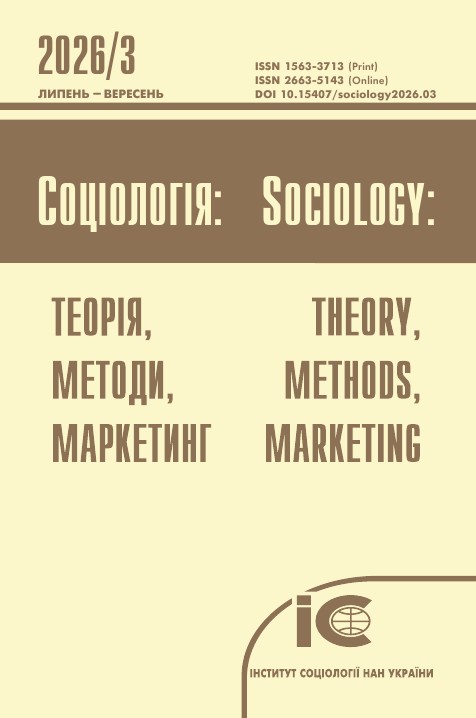
Науковий журнал "Соціологія: теорія, методи, маркетинг"
ОСТАННІЙ ДРУКОВАНИЙ НОМЕР
НАЙСВІЖІШІ МАТЕРІАЛИ У ВІДКРИТОМУ ДОСТУПІ
Онлайн-навчання та виконавська тривожність студентів-вокалістів в українському прифронтовому місті під час війни в контексті соціології музики
stmm. 2026 (3): 176–191
DOI https://doi.org/10.15407/sociology2026.03.176
Повний текст: https://stmm.in.ua/archive/ukr/2026-3/12.pdf
КАТЕРИНА БАТАЄВА, доктор філософських наук, професор кафедри соціально-реабілітаційних технологій, Житомирський економіко-гуманітарний інститут, Університет «Україна» (10020, Житомир, вул. Вільський Шлях, 18)
bataevaekaterina72@yahoo.com
https://orcid.org/0000-0002-4628-4817
SCOPUS ID: 57204186366
ОЛЬГА БАТАЄВА, провідний концертмейстер кафедри сольного співу та оперної підготовки, Харківський національний університет мистецтв ім. І.П. Котляревського (61000, Харків, майдан Конституції, 11/13)
olhabataieva69@meta.ua
https://orcid.org/0009-0000-6180-5265
У цій статті ми досліджуємо специфіку онлайн-навчання та виконавської тривожності студентів-вокалістів у прифронтовому місті Харкові під час російсько-української війни. Емпірична частина статті базується на результатах дослідження, проведеного з вересня по грудень 2025 року з використанням напівструктурованого інтерв’ю з дванадцятьма студентами-вокалістами Харківського національного університету мистецтв імені І. Котляревського. У статті порівнюються (1) онлайн-навчання вокалу з очними заняттями з професійними піаністами й викладачами та (2) онлайн-виступи на віртуальних концертах з участю в живих концертах, які проводилися під час війни у підвалах Харкова або у безпечніших містах України. Дослідження виявило певні недоліки онлайн-навчання студентів-вокалістів під час війни: погана акустика вдома; відсутність емоційного та фізичного контакту з викладачем та піаністом-акомпаніатором; відсутність або значне обмеження публічних виступів; нереґулярні заняття з вокалу; зниження мотивації до навчання. До переваг онлайн-навчання студентів вокального факультету належать можливість зосередитися на самоосвіті; вдосконалення навичок роботи з різними інтернет-платформами для редаґування аудіо та відео; вдосконалення навичок критичного самоаналізу щодо своїх виступів на основі відеозаписів. Також у дослідженні було виявлено два чинники, що впливають на виконавську тривожність студентів-вокалістів під час війни: тривале онлайн-навчання та неґативні емоції, пов’язані з частими обстрілами прифронтового міста. Зроблено висновок, що тривале онлайн-навчання перериває досвід публічних виступів студентів-вокалістів перед живою авдиторією, що не сприяє формуванню самоефективності музиканта (особливо якщо це відбувається під час формування їхньої професійної ідентичності).
Ключові слова: онлайн-навчання, виконавська тривожність, студенти-вокалісти, війна, соціологія музики
Джерела:
ACLED’s Ukraine Conflict Monitor. (2025). Retrieved from: https://acleddata.com/monitor/ukraine-conflict-monitor
Bandura, A. (1997). Self-efficacy: The exercise of control. New York: W.H. Freeman and Co.
Bataeva, E. & von Löwis, S. (2025). Higher Education in a Frontline City During the Russian-Ukrainian War and COVID-19 Pandemic. In: O. Lytvynov, V. Pavlikov, D. Krytskyi (Eds.), Lecture Notes in Networks and Systems (1474, pp. 156–167). Cham, ZUG: Springer. https://doi.org/10.1007/978-3-031-94852-7_13
Bataeva, K. (2025). Higher education in a frontline city during the Russian-Ukrainian war: cumulative effects of prolonged online learning. [In Ukrainian]. Sociology: Theory, Methods, Marketing, 2, 116–134. https://doi.org/10.15407/sociology2025.02.116 [=Батаєва, К. (2025). Вища освіта у прифронтовому місті під час російсько-української війни: кумулятивні ефекти пролонґованого онлайн-навчання. Соцiологiя: теорiя, методи, маркетинг, 2, 116–134].
Bataeva, E. (2026). Front line and frontline cities during the Russian-Ukrainian war in the context of border and urban studies. Journal of Borderlands Studies, 1–25. https://doi.org/10.1080/08865655.2026.2637495
Biasutti, M., Antonini Philippe, R., & Schiavio, A. (2022). Assessing teachers’ perspectives on giving music lessons remotely during the COVID-19 lockdown period. Musicae Scientiae, 26(3), 585–603. https://doi.org/10.1177/1029864921996033
Biwer, F., Wiradhany, W., Oude Egbrink, M., Hospers, H., Wasenitz, S., Jansen, W. et al. (2021). Changes and adaptations: how University students self-regulate their online learning during the COVID-19 pandemic. Frontiers in Psychology, 12, 1–12. https://doi.org/10.3389/fpsyg.2021.642593
Barbeau, A.-K., Boucher, H., & Héroux, I. (2023). The effects of the pandemic on music teaching in schools in Quebec (Canada) in the spring and fall of 2020. International Journal of Music Education, 42(2), 285–299. https://doi.org/10.1177/02557614231157101
Barros, S., Marinho, H., França, A. B., & Pereira, A. (2024). Music performance anxiety: A study of anxiety predictors in higher education music students in Portugal. International Journal of Music Education, September. https://doi.org/10.1177/02557614241280040
Calderуn-Garrido, D. & Gustems-Carnicer, G. (2021). Adaptations of music education in primary and secondary school due to COVID-19: The experience in Spain. Music Education Research, 23(2), 139–150. https://doi.org/10.1080/14613808.2021.1902488
Camlin, D. & Lisboa, T. (2021). The digital ‘turn’ in music education (editorial). Music Education Research, 23(2), 129–138. https://doi.org/10.1080/14613808.2021.1908792
Casanova, O., Zarza, F.J., & Orejudo, S. (2018). Differences in performance anxiety levels among advanced conservatory students in Spain, according to type of instrument and academic year of enrolment. Music Education Research, 20, 377–389. https://doi.org/10.1080/14613808.2018.1433145
Cheng, L., Lam, C.Y., & Leung, C.H. (2023). Digital competencies of music teachers under the ‘new normal’ in Hong Kong. International Journal of Music Education, 42(4), 535–549. https://doi.org/10.1177/02557614231186413
Chernyavska, M., Savchenko, H., & Borysenko, M. (2025). Situatedness generated by war: Artistic reaction of Kharkiv musicians to the military aggression and its consequences. Art Design and Communication in Higher Education 24(1): 77–94. https://doi.org/10.1386/adch_00109_1
Coşkun-Şentürk, G. & Çırakoğlu, O.C. (2017). How guilt/shame proneness and coping styles are related to music performance anxiety and stress symptoms by gender. Psychology of Music, 46(5), 682–698. https://doi.org/10.1177/0305735617721338
Crawford, R. (2017). Rethinking teaching and learning pedagogy for education in the twenty-first century: blended learning in music education. Music Education Research, 19(2), 195–213. http://dx.doi.org/10.1080/14613808.2016.1202223
Dammers, R.J. (2009). Utilizing internet-based videoconferencing for instrumental music lessons. Update Applications of Research in Music Education, 28, 17–24. https://doi.org/10.1177/8755123309344159
De Bruin, L. (2021). Instrumental music educators in a COVID landscape: a reassertion of relationality and connection in teaching practice. Frontiers in Psychology, 11, 1–12. https://doi.org/10.3389/fpsyg.2020.624717
Dembitskyi, S., Golovakha, Ye., Stepanenko, V. (2025). Stressful conditions of the Ukrainian population in the context of war: experience of sociological research. [In Ukrainian]. Kyiv: Institute of Sociology, NAS of Ukraine. [=Дембіцький, С., Головаха, Є., Степаненко, В. (2025). Стресові стани населення України в контексті війни: досвід соціологічного вивчення. Київ: Інститут соціології НАН України].
Dembitskyi, S., Stepanenko, V., Zlobina, O., Golovakha, Ye., Naidionova, L. (2024). Psychological stressors of wartime: prevalence and effects among the population of Ukraine. [In Ukrainian]. Sociology: Theory, Methods, Marketing, 4, 5–26. https://doi.org/10.15407/sociology2024.04.005 [=Дембіцький, С., Степаненко, В., Злобіна, О., Головаха, Є., Найдьонова, Л. (2024). Психологічні стресори військового часу: поширеність та ефекти серед населення України. Соцiологiя: теорiя, методи, маркетинг, 4, 5–26].
Densley, B., Andrews, K., & Flynn, T. (2025). How Australian singers experienced disruption to choir participation caused by pandemic lockdowns: A thematic analysis. Psychology of Music, 53(1), 111–126. https://doi.org/10.1177/03057356241234052
Digolo, B.A., Andang’o, E.A., & Katuli, J. (2011). E-Learning as a Strategy for Enhancing Access to Music Education. International Journal of Business and Social Science, 1(11), 135–139.
Dobos, B., Piko, B.F., & Kenny, D.T. (2019). Music performance anxiety and its relationship with social phobia and dimensions of perfectionism. Research Studies in Music Education, 41(3), 310–326. https://doi.org/10.1177/1321103X18804295
Filanová, J., Ondrašová, I. & Töröková, A. (2020). Quality evaluation of audio and video signals in videoconferences. Acta Polytechnica Hungarica, 17(7), 89–108. https://doi.org/10.12700/APH.17.7.2020.7.5
Franěk, M. (2009). Is noise sensitivity influenced by musical factors. In: 10th WSEAS International Conference on Acoustics & Music: Theory & Applications. Wiscons, United States. Retrieved from: https://www.researchgate.net/publication/228436041_Is_noise_sensitivity_influenced_by_musical_factors
Gaunt, H. (2011). Understanding the one-to-one relationship in instrumental/vocal tuition in Higher Education: comparing student and teacher perceptions. British Journal of Music Education, 28, 159–179. https://doi.org/10.1017/S0265051711000052
Hash, P.M. (2021). Remote learning in school bands during COVID-19 shutdown. Journal of Research in Music Education, 68(4), 381–397. https://doi.org/10.1177/0022429420967008
Hernández, A.M. (2021). Online learning in higher music education: Benefits, challenges and drawbacks of one-to-one videoconference instrumental lessons. Journal of Music, Technology and Education, 13(2–3), 181–197. https://doi.org/10.1386/jmte_00022_1
International organization for migration (IOM). (2024). Retrieved from: https://dtm.iom.int/reports/ukraine-thematic-brief-frontline-mobility-and-needs-monitoring-may-2024
Iusca, D. & Dafinoiu, I. (2012). Performance anxiety and musical level of undergraduate students in exam situations: The role of gender and musical instrument. Procedia — Social and Behavioral Sciences, 33, 448–452. https://doi.org/10.1016/j.sbspro.2012.01.161
Kaleсska-Rodzaj, J. (2023). Emotionality and performance: An emotion-regulation approach to music performance anxiety. Musicae Scientiae, 27(4), 842–861. https://doi.org/10.1177/10298649231173565
Kenny, D.T., Davis, P.J., & Oates, J. (2004). Music performance anxiety and occupational stress amongst opera chorus artists and their relationship with state and trait anxiety and perfectionism. Journal of Anxiety Disorders, 18, 757–777. https://doi.org/10.1016/j.janxdis.2003.09.004
Kenny, D.T., Driscoll, T., & Ackermann, B. (2012). Psychological well-being in professional orchestral musicians in Australia: A descriptive population study. Psychology of Music, 42, 210–232. https://doi.org/10.1177/0305735612463950
Kirchner, J.M., Bloom, A.J., & Skutnick-Henley, P. (2008). The relationship between performance anxiety and flow. Medical Problems of Performing Artists, 23(2), 59–65.
Kurapov, A., Pavlenko, V., Drozdov, A., Korchakova, N., & Pavlova, I. (2024). Impact of War on Ukrainian University Students and Personnel: Repeated Cross-Sectional Study. Journal of Loss and Trauma, 29, 1–17. https://doi.org/10.1080/15325024.2024.2433990
Kurkul, W. (2007). Nonverbal communication in one-to-one music performance instruction. Psychology of Music, 35(2), 327–362. https://doi.org/10.1177/0305735607070385
Lisboa, T., Jуnasson, P., & Johnson, C. (2020). Synchronous online learning, teaching and performing. In: G. McPherson (Ed.), The Oxford Handbook of Music Performance (vol. 2, pp. 499–527). Oxford: Oxford University Press. https://doi.org/10.1093/oxfordhb/9780190058869.013.23
López-Íñiguez, G. & McPherson, G.E. (2021). Regulation of emotions to optimize classical music performance: A quasi-experimental study of a cellist-researcher. Frontiers in Psychology, 12, 1–12. https://doi.org/10.3389/fpsyg.2021.627601
McClellan, E., Vestby, S., Lang, J., & Ehrlich, A. (2023). Sociological Aspects of Music Education in Higher Education in Brazil, Canada, Israel, Norway, and the United States During the COVID-19 Pandemic. Visions of Research in Music Education, 42, 1–20.
McCormick, J. & McPherson, G.E. (2003). The role of self-efficacy in a musical performance examination: an exploratory structural equation analysis. Psychology of Music, 31, 37–51. https://doi.org/10.1177/0305735603031001322
Naydonova, L., Dembitskyi, S., & Stepanenko, V. (2024). Predictors and protectors of the risk of developing post-traumatic stress disorder in Ukrainians as a result of the Russian-Ukrainian war: Demographic aspects and war stressors. Scientific Studios on Social and Political Psychology, 31(2), 6–16. https://doi.org/10.61727/sssppj/2.2024.06
Nugroho, D. & Biasutti, M. (2024). Instructors’ perspectives on teaching music online after the COVID-19 lockdown: A qualitative analysis in Indonesia. Journal of University Teaching and Learning Practice, 21(3), 1–26. https://doi.org/10.53761/3dqqzp79
Nusseck, M. & Spahn, C. (2021). Musical practice in music students during COVID-19 lockdown. Frontiers in Psychology, 12, 1–8. https://doi.org/10.3389/fpsyg.2021.643177
Orejudo, S., Zarza, F.J., Casanova, O., Rodríguez, C., & Mazas, B. (2017). The relation of music performance anxiety (MPA) to optimism, self-efficacy, and sensitivity to reward and punishment: Testing Barlow’s theory of personal vulnerability on a sample of Spanish music students. Psychology of Music, 45(4), 570–583. https://doi.org/10.1177/0305735616674791
Paliaukiene, V., Kazlauskas, E., Eimontas, J., & Skeryte-Kazlauskiene, M. (2018). Music performance anxiety among students of the academy in Lithuania. Music Education Research, 20, 390–397. https://doi.org/10.1080/14613808.2018.1445208
Pekrun, R., Goetz, T., Frenzel, A.C., Barchfeld, P., & Perry, R.P. (2011). Measuring emotions in students’ learning and performance: The Achievement Emotions Questionnaire (AEQ). Contemporary Educational Psychology, 36(1), 36–48. https://doi.org/10.1016/j.cedpsych.2010.10.002
Perdomo-Guevara, E. & Dibben, N. (2025). Cultivating meaning and self-transcendence to increase positive emotions and decrease anxiety in music performance. Psychology of Music, 53(3), 337–354. https://doi.org/10.1177/03057356241246052
Riley, H., MacLeod, R., & Libera, M. (2016). Low latency audio video. Applications of Research in Music Education, 34(3), 15–23. https://doi.org/10.1177/8755123314554403
Rucsanda, M.D., Belibou, A., & Cazan, A. (2021). Students’ Attitudes Toward Online Music Education During the COVID 19 Lockdown. Frontiers in Psychology, 12, 1–10. https://doi.org/10.3389/fpsyg.2021.753785
Schmidt-Jones, C.A. (2017). The promise and challenge of online action research: notes from a study of self-motivated online music learners. Action Research, 18, 372–386. https://doi.org/10.1177/1476750317698026
Setiarini, A. (2021). Distance learning for music practice in college: Benefits, drawbacks, and challenges. Grenek Music Journal, 10(2), 43–53. http://dx.doi.org/10.24114/grenek.v10i2.27900
Simones, L.L., Rodger, M., & Schroeder, F. (2015). Communicating musical knowledge through gesture: Piano teachers’ gestural behaviours across different levels of student proficiency. Psychology of Music, 43(5), 723–735. https://psycnet.apa.org/doi/10.1177/0305735614535830
Smith, G., Moir, Z., Ferguson, P., & Davies, G. (2020). Low-latency networked music collaborations: Does “good enough” do enough good? Journal of Network Music and Arts, 2, 1–23.
Stepanenko, V., Zlobina, O., Golovakha, Ye., Dembitskyi, S., Naidionova, L. (2023). Stress caused by war and resources of socio-psychological resilience: a review of theoretical conceptualizations. [In Ukrainian]. Sociology: Theory, Methods, Marketing, 4, 22–39 https://doi.org/10.15407/sociology2023.04.022 [=Степаненко, В., Злобіна, О., Головаха, Є., Дембіцький, С., Найдьонова, Л. (2023). Стрес, спричинений війною, та ресурси соціально-психологічної стійкості: огляд теоретичних концептуалізацій. Соцiологiя: теорiя, методи, маркетинг, 4, 22–39].
Stieger, S., Lewetz, D., Paschenko, S., & Kurapov, A. (2023). Examining terror management theory in Ukraine: impact of air-raid alarms and explosions on mental health, somatic symptoms, and well-being. Frontiers in Psychiatry, 14, 1–16. https://doi.org/10.3389/fpsyt.2023.1244335
The Swedish Research Council. (2017). Retrieved from: https://www.vr.se/english/analysis/reports/our-reports/2017-08-31-good-research-practice.html
Tsugawa, S. (2023). Bridging the Digital Divide: Distance music learning among older adult musicians. International Journal of Music Education, 41(1), 52–68. https://doi.org/10.1177/02557614221091888
Varadi, J., Miklos Radocz, J., Mike, A., Ovary, Z., & Jozsa, G. (2024). Lessons from the COVID pandemic in music education the advantages and disadvantages of online music education. Heliyon, 10(18), 1–9. https://doi.org/10.1016/j.heliyon.2024.e35357
Yıldız, Y., Karşal, E., & Bağcı, H. (2021). Examining the instructors’ perspectives on undergraduate distance learning music instrument education during the COVID-19 pandemic. Journal of Pedagogical Research, 5(2), 184–206. https://doi.org/10.33902/JPR.2021270107
Yondem, Z.D. (2007). Performance anxiety, dysfunctional attitudes and gender in university music students. Social Behavior and Personality, 35(10), 1415–1426. https://doi.org/10.2224/sbp.2007.35.10.1415
Zarza, F.J., Orejudo, S., Casanova, O., & Aparicio-Moreno, L. (2018). Music performance anxiety in adolescence and early adulthood: Its relation with the age of onset in musical training. Psychology of Music, 46(1), 1–15. https://doi.org/10.1177/0305735617691592
Zarza-Alzugaray, F.J., Casanova, O., McPherson, G.E., & Orejudo, S. (2020). Music Self-Efficacy for Performance: An Explanatory Model Based on Social Support. Frontiers in Psychology, 11, 1–14. https://doi.org/10.3389/fpsyg.2020.01249
Zelenak, M.S. (2020). Developing Self-Efficacy to Improve Music Achievement. Music Educators Journal, 107(2): 42–50. https://doi.org/10.1177/0027432120950812
Отримано 07.02.2026
Прийнято до друку після рецензування 12.06.2026
Онлайн-навчання та виконавська тривожність студентів-вокалістів в українському прифронтовому місті під час війни в контексті соціології музики
stmm. 2026 (3): 176–191
DOI https://doi.org/10.15407/sociology2026.03.176
Повний текст: https://stmm.in.ua/archive/ukr/2026-3/12.pdf
КАТЕРИНА БАТАЄВА, доктор філософських наук, професор кафедри соціально-реабілітаційних технологій, Житомирський економіко-гуманітарний інститут, Університет «Україна» (10020, Житомир, вул. Вільський Шлях, 18)
bataevaekaterina72@yahoo.com
https://orcid.org/0000-0002-4628-4817
SCOPUS ID: 57204186366
ОЛЬГА БАТАЄВА, провідний концертмейстер кафедри сольного співу та оперної підготовки, Харківський національний університет мистецтв ім. І.П. Котляревського (61000, Харків, майдан Конституції, 11/13)
olhabataieva69@meta.ua
https://orcid.org/0009-0000-6180-5265
У цій статті ми досліджуємо специфіку онлайн-навчання та виконавської тривожності студентів-вокалістів у прифронтовому місті Харкові під час російсько-української війни. Емпірична частина статті базується на результатах дослідження, проведеного з вересня по грудень 2025 року з використанням напівструктурованого інтерв’ю з дванадцятьма студентами-вокалістами Харківського національного університету мистецтв імені І. Котляревського. У статті порівнюються (1) онлайн-навчання вокалу з очними заняттями з професійними піаністами й викладачами та (2) онлайн-виступи на віртуальних концертах з участю в живих концертах, які проводилися під час війни у підвалах Харкова або у безпечніших містах України. Дослідження виявило певні недоліки онлайн-навчання студентів-вокалістів під час війни: погана акустика вдома; відсутність емоційного та фізичного контакту з викладачем та піаністом-акомпаніатором; відсутність або значне обмеження публічних виступів; нереґулярні заняття з вокалу; зниження мотивації до навчання. До переваг онлайн-навчання студентів вокального факультету належать можливість зосередитися на самоосвіті; вдосконалення навичок роботи з різними інтернет-платформами для редаґування аудіо та відео; вдосконалення навичок критичного самоаналізу щодо своїх виступів на основі відеозаписів. Також у дослідженні було виявлено два чинники, що впливають на виконавську тривожність студентів-вокалістів під час війни: тривале онлайн-навчання та неґативні емоції, пов’язані з частими обстрілами прифронтового міста. Зроблено висновок, що тривале онлайн-навчання перериває досвід публічних виступів студентів-вокалістів перед живою авдиторією, що не сприяє формуванню самоефективності музиканта (особливо якщо це відбувається під час формування їхньої професійної ідентичності).
Ключові слова: онлайн-навчання, виконавська тривожність, студенти-вокалісти, війна, соціологія музики
Джерела:
ACLED’s Ukraine Conflict Monitor. (2025). Retrieved from: https://acleddata.com/monitor/ukraine-conflict-monitor
Bandura, A. (1997). Self-efficacy: The exercise of control. New York: W.H. Freeman and Co.
Bataeva, E. & von Löwis, S. (2025). Higher Education in a Frontline City During the Russian-Ukrainian War and COVID-19 Pandemic. In: O. Lytvynov, V. Pavlikov, D. Krytskyi (Eds.), Lecture Notes in Networks and Systems (1474, pp. 156–167). Cham, ZUG: Springer. https://doi.org/10.1007/978-3-031-94852-7_13
Bataeva, K. (2025). Higher education in a frontline city during the Russian-Ukrainian war: cumulative effects of prolonged online learning. [In Ukrainian]. Sociology: Theory, Methods, Marketing, 2, 116–134. https://doi.org/10.15407/sociology2025.02.116 [=Батаєва, К. (2025). Вища освіта у прифронтовому місті під час російсько-української війни: кумулятивні ефекти пролонґованого онлайн-навчання. Соцiологiя: теорiя, методи, маркетинг, 2, 116–134].
Bataeva, E. (2026). Front line and frontline cities during the Russian-Ukrainian war in the context of border and urban studies. Journal of Borderlands Studies, 1–25. https://doi.org/10.1080/08865655.2026.2637495
Biasutti, M., Antonini Philippe, R., & Schiavio, A. (2022). Assessing teachers’ perspectives on giving music lessons remotely during the COVID-19 lockdown period. Musicae Scientiae, 26(3), 585–603. https://doi.org/10.1177/1029864921996033
Biwer, F., Wiradhany, W., Oude Egbrink, M., Hospers, H., Wasenitz, S., Jansen, W. et al. (2021). Changes and adaptations: how University students self-regulate their online learning during the COVID-19 pandemic. Frontiers in Psychology, 12, 1–12. https://doi.org/10.3389/fpsyg.2021.642593
Barbeau, A.-K., Boucher, H., & Héroux, I. (2023). The effects of the pandemic on music teaching in schools in Quebec (Canada) in the spring and fall of 2020. International Journal of Music Education, 42(2), 285–299. https://doi.org/10.1177/02557614231157101
Barros, S., Marinho, H., França, A. B., & Pereira, A. (2024). Music performance anxiety: A study of anxiety predictors in higher education music students in Portugal. International Journal of Music Education, September. https://doi.org/10.1177/02557614241280040
Calderуn-Garrido, D. & Gustems-Carnicer, G. (2021). Adaptations of music education in primary and secondary school due to COVID-19: The experience in Spain. Music Education Research, 23(2), 139–150. https://doi.org/10.1080/14613808.2021.1902488
Camlin, D. & Lisboa, T. (2021). The digital ‘turn’ in music education (editorial). Music Education Research, 23(2), 129–138. https://doi.org/10.1080/14613808.2021.1908792
Casanova, O., Zarza, F.J., & Orejudo, S. (2018). Differences in performance anxiety levels among advanced conservatory students in Spain, according to type of instrument and academic year of enrolment. Music Education Research, 20, 377–389. https://doi.org/10.1080/14613808.2018.1433145
Cheng, L., Lam, C.Y., & Leung, C.H. (2023). Digital competencies of music teachers under the ‘new normal’ in Hong Kong. International Journal of Music Education, 42(4), 535–549. https://doi.org/10.1177/02557614231186413
Chernyavska, M., Savchenko, H., & Borysenko, M. (2025). Situatedness generated by war: Artistic reaction of Kharkiv musicians to the military aggression and its consequences. Art Design and Communication in Higher Education 24(1): 77–94. https://doi.org/10.1386/adch_00109_1
Coşkun-Şentürk, G. & Çırakoğlu, O.C. (2017). How guilt/shame proneness and coping styles are related to music performance anxiety and stress symptoms by gender. Psychology of Music, 46(5), 682–698. https://doi.org/10.1177/0305735617721338
Crawford, R. (2017). Rethinking teaching and learning pedagogy for education in the twenty-first century: blended learning in music education. Music Education Research, 19(2), 195–213. http://dx.doi.org/10.1080/14613808.2016.1202223
Dammers, R.J. (2009). Utilizing internet-based videoconferencing for instrumental music lessons. Update Applications of Research in Music Education, 28, 17–24. https://doi.org/10.1177/8755123309344159
De Bruin, L. (2021). Instrumental music educators in a COVID landscape: a reassertion of relationality and connection in teaching practice. Frontiers in Psychology, 11, 1–12. https://doi.org/10.3389/fpsyg.2020.624717
Dembitskyi, S., Golovakha, Ye., Stepanenko, V. (2025). Stressful conditions of the Ukrainian population in the context of war: experience of sociological research. [In Ukrainian]. Kyiv: Institute of Sociology, NAS of Ukraine. [=Дембіцький, С., Головаха, Є., Степаненко, В. (2025). Стресові стани населення України в контексті війни: досвід соціологічного вивчення. Київ: Інститут соціології НАН України].
Dembitskyi, S., Stepanenko, V., Zlobina, O., Golovakha, Ye., Naidionova, L. (2024). Psychological stressors of wartime: prevalence and effects among the population of Ukraine. [In Ukrainian]. Sociology: Theory, Methods, Marketing, 4, 5–26. https://doi.org/10.15407/sociology2024.04.005 [=Дембіцький, С., Степаненко, В., Злобіна, О., Головаха, Є., Найдьонова, Л. (2024). Психологічні стресори військового часу: поширеність та ефекти серед населення України. Соцiологiя: теорiя, методи, маркетинг, 4, 5–26].
Densley, B., Andrews, K., & Flynn, T. (2025). How Australian singers experienced disruption to choir participation caused by pandemic lockdowns: A thematic analysis. Psychology of Music, 53(1), 111–126. https://doi.org/10.1177/03057356241234052
Digolo, B.A., Andang’o, E.A., & Katuli, J. (2011). E-Learning as a Strategy for Enhancing Access to Music Education. International Journal of Business and Social Science, 1(11), 135–139.
Dobos, B., Piko, B.F., & Kenny, D.T. (2019). Music performance anxiety and its relationship with social phobia and dimensions of perfectionism. Research Studies in Music Education, 41(3), 310–326. https://doi.org/10.1177/1321103X18804295
Filanová, J., Ondrašová, I. & Töröková, A. (2020). Quality evaluation of audio and video signals in videoconferences. Acta Polytechnica Hungarica, 17(7), 89–108. https://doi.org/10.12700/APH.17.7.2020.7.5
Franěk, M. (2009). Is noise sensitivity influenced by musical factors. In: 10th WSEAS International Conference on Acoustics & Music: Theory & Applications. Wiscons, United States. Retrieved from: https://www.researchgate.net/publication/228436041_Is_noise_sensitivity_influenced_by_musical_factors
Gaunt, H. (2011). Understanding the one-to-one relationship in instrumental/vocal tuition in Higher Education: comparing student and teacher perceptions. British Journal of Music Education, 28, 159–179. https://doi.org/10.1017/S0265051711000052
Hash, P.M. (2021). Remote learning in school bands during COVID-19 shutdown. Journal of Research in Music Education, 68(4), 381–397. https://doi.org/10.1177/0022429420967008
Hernández, A.M. (2021). Online learning in higher music education: Benefits, challenges and drawbacks of one-to-one videoconference instrumental lessons. Journal of Music, Technology and Education, 13(2–3), 181–197. https://doi.org/10.1386/jmte_00022_1
International organization for migration (IOM). (2024). Retrieved from: https://dtm.iom.int/reports/ukraine-thematic-brief-frontline-mobility-and-needs-monitoring-may-2024
Iusca, D. & Dafinoiu, I. (2012). Performance anxiety and musical level of undergraduate students in exam situations: The role of gender and musical instrument. Procedia — Social and Behavioral Sciences, 33, 448–452. https://doi.org/10.1016/j.sbspro.2012.01.161
Kaleсska-Rodzaj, J. (2023). Emotionality and performance: An emotion-regulation approach to music performance anxiety. Musicae Scientiae, 27(4), 842–861. https://doi.org/10.1177/10298649231173565
Kenny, D.T., Davis, P.J., & Oates, J. (2004). Music performance anxiety and occupational stress amongst opera chorus artists and their relationship with state and trait anxiety and perfectionism. Journal of Anxiety Disorders, 18, 757–777. https://doi.org/10.1016/j.janxdis.2003.09.004
Kenny, D.T., Driscoll, T., & Ackermann, B. (2012). Psychological well-being in professional orchestral musicians in Australia: A descriptive population study. Psychology of Music, 42, 210–232. https://doi.org/10.1177/0305735612463950
Kirchner, J.M., Bloom, A.J., & Skutnick-Henley, P. (2008). The relationship between performance anxiety and flow. Medical Problems of Performing Artists, 23(2), 59–65.
Kurapov, A., Pavlenko, V., Drozdov, A., Korchakova, N., & Pavlova, I. (2024). Impact of War on Ukrainian University Students and Personnel: Repeated Cross-Sectional Study. Journal of Loss and Trauma, 29, 1–17. https://doi.org/10.1080/15325024.2024.2433990
Kurkul, W. (2007). Nonverbal communication in one-to-one music performance instruction. Psychology of Music, 35(2), 327–362. https://doi.org/10.1177/0305735607070385
Lisboa, T., Jуnasson, P., & Johnson, C. (2020). Synchronous online learning, teaching and performing. In: G. McPherson (Ed.), The Oxford Handbook of Music Performance (vol. 2, pp. 499–527). Oxford: Oxford University Press. https://doi.org/10.1093/oxfordhb/9780190058869.013.23
López-Íñiguez, G. & McPherson, G.E. (2021). Regulation of emotions to optimize classical music performance: A quasi-experimental study of a cellist-researcher. Frontiers in Psychology, 12, 1–12. https://doi.org/10.3389/fpsyg.2021.627601
McClellan, E., Vestby, S., Lang, J., & Ehrlich, A. (2023). Sociological Aspects of Music Education in Higher Education in Brazil, Canada, Israel, Norway, and the United States During the COVID-19 Pandemic. Visions of Research in Music Education, 42, 1–20.
McCormick, J. & McPherson, G.E. (2003). The role of self-efficacy in a musical performance examination: an exploratory structural equation analysis. Psychology of Music, 31, 37–51. https://doi.org/10.1177/0305735603031001322
Naydonova, L., Dembitskyi, S., & Stepanenko, V. (2024). Predictors and protectors of the risk of developing post-traumatic stress disorder in Ukrainians as a result of the Russian-Ukrainian war: Demographic aspects and war stressors. Scientific Studios on Social and Political Psychology, 31(2), 6–16. https://doi.org/10.61727/sssppj/2.2024.06
Nugroho, D. & Biasutti, M. (2024). Instructors’ perspectives on teaching music online after the COVID-19 lockdown: A qualitative analysis in Indonesia. Journal of University Teaching and Learning Practice, 21(3), 1–26. https://doi.org/10.53761/3dqqzp79
Nusseck, M. & Spahn, C. (2021). Musical practice in music students during COVID-19 lockdown. Frontiers in Psychology, 12, 1–8. https://doi.org/10.3389/fpsyg.2021.643177
Orejudo, S., Zarza, F.J., Casanova, O., Rodríguez, C., & Mazas, B. (2017). The relation of music performance anxiety (MPA) to optimism, self-efficacy, and sensitivity to reward and punishment: Testing Barlow’s theory of personal vulnerability on a sample of Spanish music students. Psychology of Music, 45(4), 570–583. https://doi.org/10.1177/0305735616674791
Paliaukiene, V., Kazlauskas, E., Eimontas, J., & Skeryte-Kazlauskiene, M. (2018). Music performance anxiety among students of the academy in Lithuania. Music Education Research, 20, 390–397. https://doi.org/10.1080/14613808.2018.1445208
Pekrun, R., Goetz, T., Frenzel, A.C., Barchfeld, P., & Perry, R.P. (2011). Measuring emotions in students’ learning and performance: The Achievement Emotions Questionnaire (AEQ). Contemporary Educational Psychology, 36(1), 36–48. https://doi.org/10.1016/j.cedpsych.2010.10.002
Perdomo-Guevara, E. & Dibben, N. (2025). Cultivating meaning and self-transcendence to increase positive emotions and decrease anxiety in music performance. Psychology of Music, 53(3), 337–354. https://doi.org/10.1177/03057356241246052
Riley, H., MacLeod, R., & Libera, M. (2016). Low latency audio video. Applications of Research in Music Education, 34(3), 15–23. https://doi.org/10.1177/8755123314554403
Rucsanda, M.D., Belibou, A., & Cazan, A. (2021). Students’ Attitudes Toward Online Music Education During the COVID 19 Lockdown. Frontiers in Psychology, 12, 1–10. https://doi.org/10.3389/fpsyg.2021.753785
Schmidt-Jones, C.A. (2017). The promise and challenge of online action research: notes from a study of self-motivated online music learners. Action Research, 18, 372–386. https://doi.org/10.1177/1476750317698026
Setiarini, A. (2021). Distance learning for music practice in college: Benefits, drawbacks, and challenges. Grenek Music Journal, 10(2), 43–53. http://dx.doi.org/10.24114/grenek.v10i2.27900
Simones, L.L., Rodger, M., & Schroeder, F. (2015). Communicating musical knowledge through gesture: Piano teachers’ gestural behaviours across different levels of student proficiency. Psychology of Music, 43(5), 723–735. https://psycnet.apa.org/doi/10.1177/0305735614535830
Smith, G., Moir, Z., Ferguson, P., & Davies, G. (2020). Low-latency networked music collaborations: Does “good enough” do enough good? Journal of Network Music and Arts, 2, 1–23.
Stepanenko, V., Zlobina, O., Golovakha, Ye., Dembitskyi, S., Naidionova, L. (2023). Stress caused by war and resources of socio-psychological resilience: a review of theoretical conceptualizations. [In Ukrainian]. Sociology: Theory, Methods, Marketing, 4, 22–39 https://doi.org/10.15407/sociology2023.04.022 [=Степаненко, В., Злобіна, О., Головаха, Є., Дембіцький, С., Найдьонова, Л. (2023). Стрес, спричинений війною, та ресурси соціально-психологічної стійкості: огляд теоретичних концептуалізацій. Соцiологiя: теорiя, методи, маркетинг, 4, 22–39].
Stieger, S., Lewetz, D., Paschenko, S., & Kurapov, A. (2023). Examining terror management theory in Ukraine: impact of air-raid alarms and explosions on mental health, somatic symptoms, and well-being. Frontiers in Psychiatry, 14, 1–16. https://doi.org/10.3389/fpsyt.2023.1244335
The Swedish Research Council. (2017). Retrieved from: https://www.vr.se/english/analysis/reports/our-reports/2017-08-31-good-research-practice.html
Tsugawa, S. (2023). Bridging the Digital Divide: Distance music learning among older adult musicians. International Journal of Music Education, 41(1), 52–68. https://doi.org/10.1177/02557614221091888
Varadi, J., Miklos Radocz, J., Mike, A., Ovary, Z., & Jozsa, G. (2024). Lessons from the COVID pandemic in music education the advantages and disadvantages of online music education. Heliyon, 10(18), 1–9. https://doi.org/10.1016/j.heliyon.2024.e35357
Yıldız, Y., Karşal, E., & Bağcı, H. (2021). Examining the instructors’ perspectives on undergraduate distance learning music instrument education during the COVID-19 pandemic. Journal of Pedagogical Research, 5(2), 184–206. https://doi.org/10.33902/JPR.2021270107
Yondem, Z.D. (2007). Performance anxiety, dysfunctional attitudes and gender in university music students. Social Behavior and Personality, 35(10), 1415–1426. https://doi.org/10.2224/sbp.2007.35.10.1415
Zarza, F.J., Orejudo, S., Casanova, O., & Aparicio-Moreno, L. (2018). Music performance anxiety in adolescence and early adulthood: Its relation with the age of onset in musical training. Psychology of Music, 46(1), 1–15. https://doi.org/10.1177/0305735617691592
Zarza-Alzugaray, F.J., Casanova, O., McPherson, G.E., & Orejudo, S. (2020). Music Self-Efficacy for Performance: An Explanatory Model Based on Social Support. Frontiers in Psychology, 11, 1–14. https://doi.org/10.3389/fpsyg.2020.01249
Zelenak, M.S. (2020). Developing Self-Efficacy to Improve Music Achievement. Music Educators Journal, 107(2): 42–50. https://doi.org/10.1177/0027432120950812
Отримано 07.02.2026
Прийнято до друку після рецензування 12.06.2026
ОСТАННІЙ ДРУКОВАНИЙ НОМЕР
НАЙСВІЖІШІ МАТЕРІАЛИ У ВІДКРИТОМУ ДОСТУПІ