Науковий журнал "Соціологія: теорія, методи, маркетинг"
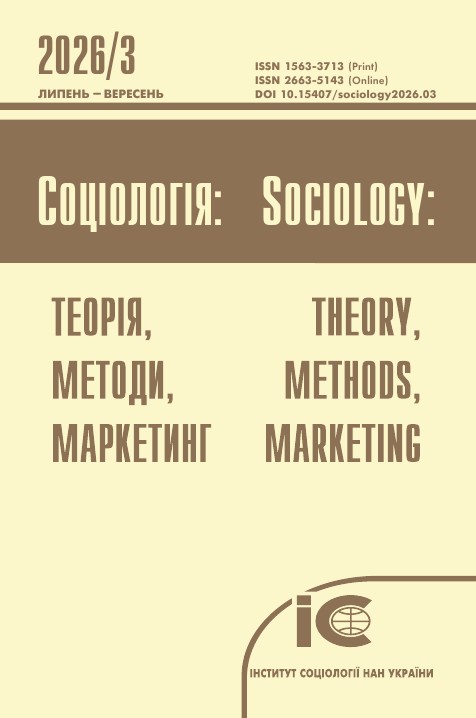
ОСТАННІЙ ДРУКОВАНИЙ НОМЕР
НАЙСВІЖІШІ МАТЕРІАЛИ У ВІДКРИТОМУ ДОСТУПІ
Ролі соціології в Україні під час війни та її внесок у ґлобальну соціологію
stmm. 2026 (2): 29–48
DOI https://doi.org/10.15407/sociology2026.02.029
Повний текст: https://stmm.in.ua/archive/ukr/2026-2/5.pdf
ДЖЕФРІ ПЛЕЄРС, президент Міжнародної соціологічної асоціації (ISA), професор соціології Лувенського католицького університету (Бельгія); директор із досліджень Національного фонду наукових досліджень (Бельгія)
Geoffrey.Pleyers@uclouvain.be
https://orcid.org/0000-0001-9949-5047
Якою є відповідальність соціології в країні, що бореться за власне виживання? Від 2022 року українські соціологи продовжують здійснювати дослідження, викладати, документувати воєнні злочини, аналізувати демократичні цінності та підтримувати громадянські ініціативи в умовах надзвичайної дестабілізації. У статті осмислюються ролі, які українська соціологія взяла на себе в період повномасштабного вторгнення: фіксація стрімких соціальних трансформацій, підтримання відданості демократичним принципам, викриття фейків та історициду, а також внесок у суспільну резильєнтність і формування повоєнних уявлень про майбутнє.
Стаття написана з позиції західноєвропейського соціолога. Спираючись на підхід ґлобальної соціології, що прагне діалогу між різними контекстами, стаття розміщує український досвід у ширшому порівняльному полі, співвідносячи його з напрацюваннями соціологів, що працюють в умовах репресій і масового насильства на Філіппінах і в Палестині. Ці випадки подаються не як еквівалентні, а радше як аналітичні оптики, що висвітлюють спільні методологічні дилеми та етичні виклики: документування насильства, конструювання дослідницьких стратегій, які залишаються значущими для учасників, а також балансування між науковою строгістю та громадянською залученістю.
Цей текст запрошує до колективної рефлексії щодо методологічних адаптацій, епістемологічних напружень, емоційних навантажень і відповідальності виробництва знання в умовах війни. Розміщуючи українську соціологію в діалозі з ширшими дебатами про публічну соціологію та дослідження в екстремальних контекстах, стаття підкреслює як визначні досягнення дисципліни, так і виклики — зокрема втому від війни, крихкість демократичних інституцій і ризики їхнього розмивання. Українська соціологія постає не лише як резильєнтна, а й як вагомий співрозмовник для міжнародної соціологічної спільноти. Її досвід пропонує концептуальні, методологічні та етичні ресурси, здатні збагатити дослідження суспільств, що стикаються з війною, демократичною крихкістю та ґлобальними кризами.
Ключові слова: Україна, соціологія, війна, резильєнтність, публічна соціологія
Джерела:
Golovakha, Ye. & Dembitskyi, S. (Eds.). (2024). Ukrainian Society in Wartime. The Year 2024. Kyiv: Institute of Sociology, National Academy of Sciences of Ukraine. [=Головаха, Є. (ред.) & Дембіцький, С. (ред.). (2024). Українське суспільство в умовах війни. Рік 2024. Київ: Інститут соціології Національної Академії наук України.]
Arugay, A. & Baquisal, J. (2023). Bowed, bent, & broken: Duterte’s assaults on civil society in the Philippines. Journal of Current Southeast Asian Affairs, 42(3), 328–349. https://doi.org/10.1177/18681034231209504
Bakirov, V. & Golovakha, Ye. (Eds.). (2018). Ukrainian Sociology in the 21st Century: Theory, Methods, Research Results. Kharkiv: V.N. Karazin Kharkiv National University.
Bakirov, V. (2025). The Phenomenon of Ukrainian Resilience: The Synergy of Sociocultural Factors. Keynote at the Fifth Ukrainian Congress of Sociology, 20–21 November. Retrieved from: https://sau.in.ua/
Bakke, K., Dahl, M., & Rickard, K. (2025). Conflict exposure and democratic values: Evidence from wartime Ukraine. Journal of Peace Research, 62(5), 1376–1392. https://doi.org/10.1177/00223433251347769
Bloch, E. (1986 [1954]). The Principle of Hope. Vol. 1. Cambridge, MA: MIT Press.
Boichak, O. & McKernan, B. (2024). Narratives of volunteering and social change in wartime Ukraine. Cultural Sociology, 18(1), 48–71.
Bradshaw, S., Elswah, M., Haque, M., & Quelle, D. (2024). Strategic storytelling: Russian state-backed media coverage of the Ukraine war. International Journal of Public Opinion Research, 36(3), edae028. https://doi.org/10.1093/ijpor/edae028
Burawoy, M. (2021). Public Sociology. Cambridge: Polity.
Coles, J., Astbury, J., Dartnall, E., & Limjerwala, S. (2014). A qualitative exploration of researcher trauma and researchers’ responses to investigating sexual violence. Violence Against Women, 20(1), 95–117. https://doi.org/10.1177/1077801213520578
Costas, J., Prokhorova, A., Stepanenko, V., Sudyn, D., Yermolenko, V., & Zaremba-Kosovych, H. (2024). Academic activism in time of war: Voices from Ukraine. Organization, 32(5), 760–771. https://doi.org/10.1177/13505084241284487
Emeran, C. (2017). New Generation Political Activism in Ukraine 2000–2014. Routledge.
Fassin, D. (2025). Moral Abdication: How the World Failed to Stop the Destruction of Gaza. London: Verso.
Golovakha, Y., Ivashchenko-Stadnik, K., Mikheieva, O., & Sereda, V. (2023). From patronalism to civic belonging: The changing dynamics of the national-civic identity in Ukraine. In: B. Madlovics & B. Magyar (Eds.), Ukraine's Patronal Democracy and the Russian Invasion (pp. 297–329). Vienna: Central European University Press.
Grushetsky, A. & Paniotto, V. (2025). War and the Transformation of Ukrainian society (2022–23). Empirical Evidence. Stuttgart: Ibidem Press.
Grzebyk P. & Uczkiewicz, D. (Eds.). (2025). The Russian-Ukrainian Conflict and War Crimes: Challenges for Documentation and International Prosecution. Routledge.
Holovakha, Ye. (2025). Socio-political transformations in contemporary Ukrainian society. Guest lecture at the Ivan Franko National University of Lviv, 30 October. Retrieved from: https://lnu.edu.ua/lvivskyy-universytet-vidvidav-profesor-yevhen-holovakha/
Hrybenko, O. (2025). Intermediaries of change: How media-focused non-governmental organizations shape meta-journalistic discourse in Ukraine. Journalism, 26(4), 862–880.
ISAR Ednannia. (2023). A study of recovery initiatives in Ukraine: Mapping post-war recovery initiatives (2022–March 2023). KIIS – Kyiv International Institute of Sociology. Retrieved from: https://ednannia.ua/images/A_study_of_recovery_initiatives_in_Ukraine.pdf
Jawad, R., Dawani, S., Shehadeh, S., & Nateel, B. (2025). Against Frames of Trauma and Testimony: Palestinian children’s narratives from within a contemporary genocide. Journal of Palestine Studies, 54(3), 71–82.
Karakai, D. & Moskotina, R. (2025). Existential upheavals: Tracing war’s immediate effect on individual religiosity in Ukraine. Social Compass, 72(1), 66–85. https://doi.org/10.1177/00377686241311421
KIIS – Kyiv International Institute of Sociology. (2024). To what extent do Ukrainians consider Ukraine a democratic country and the priority of a democratic system? Retrieved from: https://kiis.com.ua/?lang=eng&cat=reports&id=1406&page=1
Klein, E. et al. (2025). Public opinion research in Ukraine under wartime conditions. Ukrainian Analytical Digest, 6, 2–4. [ETH Zurich Research Collection].
Klosterkamp, S., Jeffrey, A. (2024). The intimate geopolitics of evidence gathering in war crime investigation in Ukraine. Political Geography Open Research, 3, 100008. https://doi.org/10.1016/j.jpgor.2024.100008
Kostenko, A. et al. (2024). Resilience and vulnerability of Ukrainians: The role of family during the war. Problems and Perspectives in Management, 22(1), 432–445. https://doi.org/10.21511/ppm.22(1).2024.35
Krymets, L., Saienko, O., Nedvyha, O., Tserkovnyak-Horodets’ka, O., & Logvinenko, N. (2025). The formation of Ukrainian national identity in the context of Russian aggression: A philosophical and psychological analysis. International Journal on Culture, History, and Religion, 7(SI1), 518–536. https://doi.org/10.63931/ijchr.v7iSI1.153
Kutsenko, O. & Babenko, S. (2024). The power of Ukrainian sociology in post-USSR transformations and Russia’s war in Ukraine. Іn: B. Roncevic & T.B. Valič (Eds.), Sociology and Post-Socialist Transformations in Eastern Europe (pp. 437–462). London: Springer.
Kutsenko, O. (2025a). Democratic resilience: Ukrainian alternative to militant authoritarianism. Іn: B. Wejnert (Ed.), The Global Rise of Autocracy: Its Threat to a Sustainable Future (pp. 251–285). London: Routledge. https://doi.org/10.4324/9781003516583-15
Kutsenko, O. (2025b). La sociologie ukrainienne face à la guerre: défis, adaptations et pratiques de recherche. Socio-logos, 21. Retrieved from: http://journals.openedition.org/socio-logos/7013
Kutsenko, O. (2025c). Resilience under fire: Navigating societal challenges, agency, and innovation in times of war. Innovation: The European Journal of Social Science Research, 38(1), 1–10. https://doi.org/10.1080/13511610.2025.2465177
Lavrysh, Y., Lytovchenko, I., Lukianenko, V., & Golub, T. (2025). Teaching during wartime: Experience from Ukraine. Educational Philosophy and Theory, 57(3), 197–204. https://doi.org/10.1080/00131857.2022.2098714
Levitas, R. (2013). Utopia as Method: The Imaginary Reconstitution of Society. Palgrave.
Mishalova, O., Hordiichuk, O., & Sokolovskyi, O. (2024). Russia’s war in Ukraine as a “war for identity” and appropriation of cultural tradition. Ethics in Progress, 15(1), 73–94. https://doi.org/10.14746/eip.2024.1.4
Musleh, A. (2026). Weaving life through stories: Lamlamah – the art of gathering and uplifting “ourselves”. Critical and Radical Social Work, 20, 1–16.
Nechitailo, I. & Alieva, A. (2025). Resilience of the educational system in conditions of global social upheavals: The ratio of centralization and autonomy. Innovation: The European Journal of Social Science Research, 38(1), 28–49. https://doi.org/10.1080/13511610.2025.2462959
Nekoliak, R. (2025). The Centre for Civil Liberties. In: P. Grzebyk & D. Uczkiewicz (Eds.), The Russian-Ukrainian Conflict and War Crimes: Challenges for Documentation and International Prosecution (pp. 159–175). Routledge.
OHCHR/UN. (2026). Ukraine: Protection of civilians in armed conflict. December 2025 update. Office of the United Nations High Commissioner for Human Rights. Retrieved from: https://ukraine.ohchr.org/sites/default/files/2026-01/Ukraine%20-%20protection%20of%20civilians%20in%20armed%20conflict%20%28December%202025%29_ENG.pdf
Oinas, E., Onodera, H., & Suurpää, L. (Eds.). (2018). What politics? Youth and political engagement in Africa. Brill.
Oleinik, A. (2018). Building Ukraine from within: A sociological, institutional, and economic analysis of a nation-state in the making. Stuttgart: Ibidem Press.
Oleinik, A. & Paniotto, V. (2024). Propaganda channels and their comparative effectiveness: The case of Russia’s war in Ukraine. International Sociology, 39(3), 217–240. https://doi.org/10.1177/02685809241232637
Paniotto, V. (2024). Methods for data quality assessment in wartime surveys in Ukraine. Public opinion research in Ukraine under wartime conditions. Ukrainian Analytical Digest, 6, 9–13. [ETH Zurich Research Collection].
Pleyers, G. (2024). For a global sociology of social movements. Globalizations, 21(1), 183–195.
Pleyers, G. (2025a). A Congress to Celebrate the Resilience and Dynamism of Ukrainian Sociology. ISA President's Address to the Fifth Congress of the Sociological Association of Ukraine. ISA: Presidential Corner. Retrieved from: https://www.isa-sociology.org/uploads/imgen/2367-5th-congress-ukraine-geoffrey-pleyers.pdf
Pleyers, G. (2025b). Facts and rigour at the core of the sociological ethos. Grassroots, 19, 33–39.
Reckoning Project. (2024). Reckoning Project: our mission. Retrieved from: https://www.thereckoningproject.com
Said, E. (1984). Permission to narrate. Journal of Palestine Studies, 13(3), 27–48. https://doi.org/10.2307/2536688
Sanchez, P. (2021). Engaging in public sociology. The Philippine case. In: M. Burawoy (Ed.), The Routledge International Handbook of Public Sociology (pp. 154–172). London: Routledge.
Shalhoub-Kevorkian, N. (2024). Ashlaa’ and the genocide in Gaza: Livability against fragmented flesh. Fieldsights, 31 October. Retrieved from: www.culanth.org/fieldsights/ashlaa-and-the-genocide-in-gaza
Smith, E., Pooley, J.-A., Holmes, L., Gebbie, K., & Gershon, R. (2023). Vicarious trauma: Exploring the experiences of qualitative researchers who study traumatised populations. Disaster Medicine and Public Health Preparedness, 17, e69. https://doi.org/10.1017/dmp.2021.333
Stepanenko, V. & Stewart, S. (2025). ‘‘Who, if not us?’: Civic activism and defence in wartime Ukraine. Innovation: The European Journal of Social Science Research, 38(1), 152–168. https://doi.org/10.1080/13511610.2025.2467214
Tamer Institute for Community Education. (2019). Thirty Years of Community Education and Cultural Resistance. Ramallah: Tamer Institute for Community Education.
The Economist. (2025). Russia's summer Ukraine offensive looks like its deadliest yet. The Economist, 19 January. Retrieved from: https://www.economist.com/interactive/graphic-detail/2025/07/09/russias-summer-ukraine-offensive-looks-like-its-deadliest-so-far
Tondo, L. (2025). Israel is committing genocide in Gaza, world’s top scholars on the crime say. The Guardian, 1 September. Retrieved from: https://www.theguardian.com/world/2025/sep/01/israel-committing-genocide-in-gaza-worlds-top-scholars-on-the-say
UNHCR. (2025). 2025 Impact Report. UN: United Nations High Commissioner for Refugees. Retrieved from: https://www.unhcr.org/media/unhcr-s-2025-impact-report-response-new-emergencies-and-protracted-crises
Ward, M. (2025). How the past became a weapon of genocide in Palestine. Public Humanities, 1, e134, 1–9. https://doi.org/10.1017/pub.2025.10051
Williamson, E., Gregory, A., Abrahams, H., Aghtaie, N., Walker, S.-J., & Hester, M. (2020). Secondary trauma: Emotional safety in sensitive research. Journal of Academic Ethics, 18, 55–70. https://doi.org/10.1007/s10805-019-09348-y
Wylegala, A. (2025). Ethical and methodological challenges of documenting the war. In: P. Grzebyk & D. Uczkiewicz (Eds.), The Russian-Ukrainian conflict and war crimes: Challenges for documentation and international prosecution (pp. 145–158). Routledge.
Zayachuk, Y. (2025). Ensuring quality higher education in Ukraine in times of war. Journal of Adult and Continuing Education, 31(1), 135–159. https://doi.org/10.1177/14779714241270254
Отримано 31.01.2026
Прийнято до друку після рецензування 30.03.2026
Ролі соціології в Україні під час війни та її внесок у ґлобальну соціологію
stmm. 2026 (2): 29–48
DOI https://doi.org/10.15407/sociology2026.02.029
Повний текст: https://stmm.in.ua/archive/ukr/2026-2/5.pdf
ДЖЕФРІ ПЛЕЄРС, президент Міжнародної соціологічної асоціації (ISA), професор соціології Лувенського католицького університету (Бельгія); директор із досліджень Національного фонду наукових досліджень (Бельгія)
Geoffrey.Pleyers@uclouvain.be
https://orcid.org/0000-0001-9949-5047
Якою є відповідальність соціології в країні, що бореться за власне виживання? Від 2022 року українські соціологи продовжують здійснювати дослідження, викладати, документувати воєнні злочини, аналізувати демократичні цінності та підтримувати громадянські ініціативи в умовах надзвичайної дестабілізації. У статті осмислюються ролі, які українська соціологія взяла на себе в період повномасштабного вторгнення: фіксація стрімких соціальних трансформацій, підтримання відданості демократичним принципам, викриття фейків та історициду, а також внесок у суспільну резильєнтність і формування повоєнних уявлень про майбутнє.
Стаття написана з позиції західноєвропейського соціолога. Спираючись на підхід ґлобальної соціології, що прагне діалогу між різними контекстами, стаття розміщує український досвід у ширшому порівняльному полі, співвідносячи його з напрацюваннями соціологів, що працюють в умовах репресій і масового насильства на Філіппінах і в Палестині. Ці випадки подаються не як еквівалентні, а радше як аналітичні оптики, що висвітлюють спільні методологічні дилеми та етичні виклики: документування насильства, конструювання дослідницьких стратегій, які залишаються значущими для учасників, а також балансування між науковою строгістю та громадянською залученістю.
Цей текст запрошує до колективної рефлексії щодо методологічних адаптацій, епістемологічних напружень, емоційних навантажень і відповідальності виробництва знання в умовах війни. Розміщуючи українську соціологію в діалозі з ширшими дебатами про публічну соціологію та дослідження в екстремальних контекстах, стаття підкреслює як визначні досягнення дисципліни, так і виклики — зокрема втому від війни, крихкість демократичних інституцій і ризики їхнього розмивання. Українська соціологія постає не лише як резильєнтна, а й як вагомий співрозмовник для міжнародної соціологічної спільноти. Її досвід пропонує концептуальні, методологічні та етичні ресурси, здатні збагатити дослідження суспільств, що стикаються з війною, демократичною крихкістю та ґлобальними кризами.
Ключові слова: Україна, соціологія, війна, резильєнтність, публічна соціологія
Джерела:
Golovakha, Ye. & Dembitskyi, S. (Eds.). (2024). Ukrainian Society in Wartime. The Year 2024. Kyiv: Institute of Sociology, National Academy of Sciences of Ukraine. [=Головаха, Є. (ред.) & Дембіцький, С. (ред.). (2024). Українське суспільство в умовах війни. Рік 2024. Київ: Інститут соціології Національної Академії наук України.]
Arugay, A. & Baquisal, J. (2023). Bowed, bent, & broken: Duterte’s assaults on civil society in the Philippines. Journal of Current Southeast Asian Affairs, 42(3), 328–349. https://doi.org/10.1177/18681034231209504
Bakirov, V. & Golovakha, Ye. (Eds.). (2018). Ukrainian Sociology in the 21st Century: Theory, Methods, Research Results. Kharkiv: V.N. Karazin Kharkiv National University.
Bakirov, V. (2025). The Phenomenon of Ukrainian Resilience: The Synergy of Sociocultural Factors. Keynote at the Fifth Ukrainian Congress of Sociology, 20–21 November. Retrieved from: https://sau.in.ua/
Bakke, K., Dahl, M., & Rickard, K. (2025). Conflict exposure and democratic values: Evidence from wartime Ukraine. Journal of Peace Research, 62(5), 1376–1392. https://doi.org/10.1177/00223433251347769
Bloch, E. (1986 [1954]). The Principle of Hope. Vol. 1. Cambridge, MA: MIT Press.
Boichak, O. & McKernan, B. (2024). Narratives of volunteering and social change in wartime Ukraine. Cultural Sociology, 18(1), 48–71.
Bradshaw, S., Elswah, M., Haque, M., & Quelle, D. (2024). Strategic storytelling: Russian state-backed media coverage of the Ukraine war. International Journal of Public Opinion Research, 36(3), edae028. https://doi.org/10.1093/ijpor/edae028
Burawoy, M. (2021). Public Sociology. Cambridge: Polity.
Coles, J., Astbury, J., Dartnall, E., & Limjerwala, S. (2014). A qualitative exploration of researcher trauma and researchers’ responses to investigating sexual violence. Violence Against Women, 20(1), 95–117. https://doi.org/10.1177/1077801213520578
Costas, J., Prokhorova, A., Stepanenko, V., Sudyn, D., Yermolenko, V., & Zaremba-Kosovych, H. (2024). Academic activism in time of war: Voices from Ukraine. Organization, 32(5), 760–771. https://doi.org/10.1177/13505084241284487
Emeran, C. (2017). New Generation Political Activism in Ukraine 2000–2014. Routledge.
Fassin, D. (2025). Moral Abdication: How the World Failed to Stop the Destruction of Gaza. London: Verso.
Golovakha, Y., Ivashchenko-Stadnik, K., Mikheieva, O., & Sereda, V. (2023). From patronalism to civic belonging: The changing dynamics of the national-civic identity in Ukraine. In: B. Madlovics & B. Magyar (Eds.), Ukraine's Patronal Democracy and the Russian Invasion (pp. 297–329). Vienna: Central European University Press.
Grushetsky, A. & Paniotto, V. (2025). War and the Transformation of Ukrainian society (2022–23). Empirical Evidence. Stuttgart: Ibidem Press.
Grzebyk P. & Uczkiewicz, D. (Eds.). (2025). The Russian-Ukrainian Conflict and War Crimes: Challenges for Documentation and International Prosecution. Routledge.
Holovakha, Ye. (2025). Socio-political transformations in contemporary Ukrainian society. Guest lecture at the Ivan Franko National University of Lviv, 30 October. Retrieved from: https://lnu.edu.ua/lvivskyy-universytet-vidvidav-profesor-yevhen-holovakha/
Hrybenko, O. (2025). Intermediaries of change: How media-focused non-governmental organizations shape meta-journalistic discourse in Ukraine. Journalism, 26(4), 862–880.
ISAR Ednannia. (2023). A study of recovery initiatives in Ukraine: Mapping post-war recovery initiatives (2022–March 2023). KIIS – Kyiv International Institute of Sociology. Retrieved from: https://ednannia.ua/images/A_study_of_recovery_initiatives_in_Ukraine.pdf
Jawad, R., Dawani, S., Shehadeh, S., & Nateel, B. (2025). Against Frames of Trauma and Testimony: Palestinian children’s narratives from within a contemporary genocide. Journal of Palestine Studies, 54(3), 71–82.
Karakai, D. & Moskotina, R. (2025). Existential upheavals: Tracing war’s immediate effect on individual religiosity in Ukraine. Social Compass, 72(1), 66–85. https://doi.org/10.1177/00377686241311421
KIIS – Kyiv International Institute of Sociology. (2024). To what extent do Ukrainians consider Ukraine a democratic country and the priority of a democratic system? Retrieved from: https://kiis.com.ua/?lang=eng&cat=reports&id=1406&page=1
Klein, E. et al. (2025). Public opinion research in Ukraine under wartime conditions. Ukrainian Analytical Digest, 6, 2–4. [ETH Zurich Research Collection].
Klosterkamp, S., Jeffrey, A. (2024). The intimate geopolitics of evidence gathering in war crime investigation in Ukraine. Political Geography Open Research, 3, 100008. https://doi.org/10.1016/j.jpgor.2024.100008
Kostenko, A. et al. (2024). Resilience and vulnerability of Ukrainians: The role of family during the war. Problems and Perspectives in Management, 22(1), 432–445. https://doi.org/10.21511/ppm.22(1).2024.35
Krymets, L., Saienko, O., Nedvyha, O., Tserkovnyak-Horodets’ka, O., & Logvinenko, N. (2025). The formation of Ukrainian national identity in the context of Russian aggression: A philosophical and psychological analysis. International Journal on Culture, History, and Religion, 7(SI1), 518–536. https://doi.org/10.63931/ijchr.v7iSI1.153
Kutsenko, O. & Babenko, S. (2024). The power of Ukrainian sociology in post-USSR transformations and Russia’s war in Ukraine. Іn: B. Roncevic & T.B. Valič (Eds.), Sociology and Post-Socialist Transformations in Eastern Europe (pp. 437–462). London: Springer.
Kutsenko, O. (2025a). Democratic resilience: Ukrainian alternative to militant authoritarianism. Іn: B. Wejnert (Ed.), The Global Rise of Autocracy: Its Threat to a Sustainable Future (pp. 251–285). London: Routledge. https://doi.org/10.4324/9781003516583-15
Kutsenko, O. (2025b). La sociologie ukrainienne face à la guerre: défis, adaptations et pratiques de recherche. Socio-logos, 21. Retrieved from: http://journals.openedition.org/socio-logos/7013
Kutsenko, O. (2025c). Resilience under fire: Navigating societal challenges, agency, and innovation in times of war. Innovation: The European Journal of Social Science Research, 38(1), 1–10. https://doi.org/10.1080/13511610.2025.2465177
Lavrysh, Y., Lytovchenko, I., Lukianenko, V., & Golub, T. (2025). Teaching during wartime: Experience from Ukraine. Educational Philosophy and Theory, 57(3), 197–204. https://doi.org/10.1080/00131857.2022.2098714
Levitas, R. (2013). Utopia as Method: The Imaginary Reconstitution of Society. Palgrave.
Mishalova, O., Hordiichuk, O., & Sokolovskyi, O. (2024). Russia’s war in Ukraine as a “war for identity” and appropriation of cultural tradition. Ethics in Progress, 15(1), 73–94. https://doi.org/10.14746/eip.2024.1.4
Musleh, A. (2026). Weaving life through stories: Lamlamah – the art of gathering and uplifting “ourselves”. Critical and Radical Social Work, 20, 1–16.
Nechitailo, I. & Alieva, A. (2025). Resilience of the educational system in conditions of global social upheavals: The ratio of centralization and autonomy. Innovation: The European Journal of Social Science Research, 38(1), 28–49. https://doi.org/10.1080/13511610.2025.2462959
Nekoliak, R. (2025). The Centre for Civil Liberties. In: P. Grzebyk & D. Uczkiewicz (Eds.), The Russian-Ukrainian Conflict and War Crimes: Challenges for Documentation and International Prosecution (pp. 159–175). Routledge.
OHCHR/UN. (2026). Ukraine: Protection of civilians in armed conflict. December 2025 update. Office of the United Nations High Commissioner for Human Rights. Retrieved from: https://ukraine.ohchr.org/sites/default/files/2026-01/Ukraine%20-%20protection%20of%20civilians%20in%20armed%20conflict%20%28December%202025%29_ENG.pdf
Oinas, E., Onodera, H., & Suurpää, L. (Eds.). (2018). What politics? Youth and political engagement in Africa. Brill.
Oleinik, A. (2018). Building Ukraine from within: A sociological, institutional, and economic analysis of a nation-state in the making. Stuttgart: Ibidem Press.
Oleinik, A. & Paniotto, V. (2024). Propaganda channels and their comparative effectiveness: The case of Russia’s war in Ukraine. International Sociology, 39(3), 217–240. https://doi.org/10.1177/02685809241232637
Paniotto, V. (2024). Methods for data quality assessment in wartime surveys in Ukraine. Public opinion research in Ukraine under wartime conditions. Ukrainian Analytical Digest, 6, 9–13. [ETH Zurich Research Collection].
Pleyers, G. (2024). For a global sociology of social movements. Globalizations, 21(1), 183–195.
Pleyers, G. (2025a). A Congress to Celebrate the Resilience and Dynamism of Ukrainian Sociology. ISA President's Address to the Fifth Congress of the Sociological Association of Ukraine. ISA: Presidential Corner. Retrieved from: https://www.isa-sociology.org/uploads/imgen/2367-5th-congress-ukraine-geoffrey-pleyers.pdf
Pleyers, G. (2025b). Facts and rigour at the core of the sociological ethos. Grassroots, 19, 33–39.
Reckoning Project. (2024). Reckoning Project: our mission. Retrieved from: https://www.thereckoningproject.com
Said, E. (1984). Permission to narrate. Journal of Palestine Studies, 13(3), 27–48. https://doi.org/10.2307/2536688
Sanchez, P. (2021). Engaging in public sociology. The Philippine case. In: M. Burawoy (Ed.), The Routledge International Handbook of Public Sociology (pp. 154–172). London: Routledge.
Shalhoub-Kevorkian, N. (2024). Ashlaa’ and the genocide in Gaza: Livability against fragmented flesh. Fieldsights, 31 October. Retrieved from: www.culanth.org/fieldsights/ashlaa-and-the-genocide-in-gaza
Smith, E., Pooley, J.-A., Holmes, L., Gebbie, K., & Gershon, R. (2023). Vicarious trauma: Exploring the experiences of qualitative researchers who study traumatised populations. Disaster Medicine and Public Health Preparedness, 17, e69. https://doi.org/10.1017/dmp.2021.333
Stepanenko, V. & Stewart, S. (2025). ‘‘Who, if not us?’: Civic activism and defence in wartime Ukraine. Innovation: The European Journal of Social Science Research, 38(1), 152–168. https://doi.org/10.1080/13511610.2025.2467214
Tamer Institute for Community Education. (2019). Thirty Years of Community Education and Cultural Resistance. Ramallah: Tamer Institute for Community Education.
The Economist. (2025). Russia's summer Ukraine offensive looks like its deadliest yet. The Economist, 19 January. Retrieved from: https://www.economist.com/interactive/graphic-detail/2025/07/09/russias-summer-ukraine-offensive-looks-like-its-deadliest-so-far
Tondo, L. (2025). Israel is committing genocide in Gaza, world’s top scholars on the crime say. The Guardian, 1 September. Retrieved from: https://www.theguardian.com/world/2025/sep/01/israel-committing-genocide-in-gaza-worlds-top-scholars-on-the-say
UNHCR. (2025). 2025 Impact Report. UN: United Nations High Commissioner for Refugees. Retrieved from: https://www.unhcr.org/media/unhcr-s-2025-impact-report-response-new-emergencies-and-protracted-crises
Ward, M. (2025). How the past became a weapon of genocide in Palestine. Public Humanities, 1, e134, 1–9. https://doi.org/10.1017/pub.2025.10051
Williamson, E., Gregory, A., Abrahams, H., Aghtaie, N., Walker, S.-J., & Hester, M. (2020). Secondary trauma: Emotional safety in sensitive research. Journal of Academic Ethics, 18, 55–70. https://doi.org/10.1007/s10805-019-09348-y
Wylegala, A. (2025). Ethical and methodological challenges of documenting the war. In: P. Grzebyk & D. Uczkiewicz (Eds.), The Russian-Ukrainian conflict and war crimes: Challenges for documentation and international prosecution (pp. 145–158). Routledge.
Zayachuk, Y. (2025). Ensuring quality higher education in Ukraine in times of war. Journal of Adult and Continuing Education, 31(1), 135–159. https://doi.org/10.1177/14779714241270254
Отримано 31.01.2026
Прийнято до друку після рецензування 30.03.2026
ОСТАННІЙ ДРУКОВАНИЙ НОМЕР
НАЙСВІЖІШІ МАТЕРІАЛИ У ВІДКРИТОМУ ДОСТУПІ